 Add to Chrome
 Add to Firefox
 Add to Edge
Post-Deterministic Distributed Systems: A New Foundation for Trustworthy Autonomous Infrastructure
Jun 01, 2026
For decades, distributed systems have typically assumed that correct participants execute protocol-specified behavior with stable, externally defined, and deterministic semantics. Classical theory has extensively parameterized network timing, communication topologies, and failure domains, but this participant model has remained comparatively fixed. The integration of autonomous reasoning engines, stochastic model-driven agents, and policy-driven actors into cloud control planes, incident response systems, and financial infrastructure challenges the universality of this assumption. These agents often produce divergent reasoning paths, distinct operational traces, and heterogeneous internal representations while achieving semantically equivalent and correct outcomes. In this paper, we introduce Post-Deterministic Distributed Systems (PDDS) as a research and engineering model for coordinating heterogeneous environments where deterministic code, stochastic models, and autonomous agents coexist. We show that classical distributed computing models form a zero-ambiguity special case of this participant-general model. We do not argue that deterministic systems disappear; rather, deterministic execution can no longer serve as the universal participant assumption for autonomous infrastructure. Finally, we outline five architectural pillars of post-deterministic infrastructure: Protocol-Driven Development, Verifiable Agentic Infrastructure, Autonomous State Control Planes, Semantic Quorum Assurance, and Epistemic State Replication. Epistemic State Replication extends persistence and consistency models from data visibility to knowledge visibility, enabling agentic memory, Verifiable Semantic Rollback, and coherence across reasoning participants. We also define a taxonomy of failure classes that arise in this setting.

GenClaw: Code-Driven Agentic Image Generation
May 28, 2026Image generation models have evolved from text-conditioned pixel synthesis toward multimodal agents endowed with visual comprehension and tool invocation capabilities. Yet, existing agents remain at the mercy of underlying black-box image models. Their workflow is trapped in a repetitive cycle of prompt rewriting for generation refinement, leaving them with no mechanism to directly manipulate the canvas. In essence, the potential of LLMs to serve as a genuine "brush" for precise visual construction remains largely untapped. In this paper, we propose GenClaw, a code-driven agentic image generation paradigm that empowers the agent to create like a human artist: first conceptualizing, then sketching, and finally coloring. Specifically, the agent first constructs the conceptual knowledge and context through search and reasoning. It then utilizes code (e.g., SVG, HTML, Three.js) to render executable visual sketches. Finally, it employs an image generation model to supplement textures, materials, and photorealism. In this workflow, code serves as a controllable intermediate canvas bridging linguistic reasoning and pixel synthesis, seamlessly integrating programmatic logic with the visual expressiveness of generative models. By transforming image generation from a black-box paradigm into a staged process akin to authentic human creation, GenClaw offers a step toward for highly controllable and interpretable visual generation systems.
Protocol-Driven Development: Governing Generated Software Through Invariants and Evidence
May 13, 2026Automated program synthesis has reduced the cost of producing candidate implementations, but it introduces a harder governance problem: determining which generated artifacts are admissible in a software system. Natural-language specifications remain semantically ambiguous, and example-based tests sample only part of the behavioral space. Used alone, neither provides a sufficient control boundary for automated software construction. We introduce Protocol-Driven Development (PDD), a development model in which the primary software artifact is a machine-enforceable protocol rather than implementation code. We define a protocol as the triplet P = (S, B, O), where S specifies structural invariants, B specifies behavioral invariants, and O specifies operational invariants. Their conjunction defines the admissible implementation space of a software component. Under PDD, implementations are treated as replaceable realizations discovered through constrained search. An implementation is admitted if and only if it satisfies the governing protocol and produces a verifiable Evidence Chain of compliance. Admission is therefore grounded not in trust in the generator, but in protocol satisfaction and recorded evidence. By combining ideas from formal methods, property-based testing, policy-as-code, and software provenance, PDD defines a governance layer for automated software engineering. Its organizing principle is simple: code is transient; protocol is sovereign.
Argus: Reorchestrating Static Analysis via a Multi-Agent Ensemble for Full-Chain Security Vulnerability Detection
Apr 08, 2026Recent advancements in Large Language Models (LLMs) have sparked interest in their application to Static Application Security Testing (SAST), primarily due to their superior contextual reasoning capabilities compared to traditional symbolic or rule-based methods. However, existing LLM-based approaches typically attempt to replace human experts directly without integrating effectively with existing SAST tools. This lack of integration results in ineffectiveness, including high rates of false positives, hallucinations, limited reasoning depth, and excessive token usage, making them impractical for industrial deployment. To overcome these limitations, we present a paradigm shift that reorchestrates the SAST workflow from current LLM-assisted structure to a new LLM-centered workflow. We introduce Argus (Agentic and Retrieval-Augmented Guarding System), the first multi-agent framework designed specifically for vulnerability detection. Argus incorporates three key novelties: comprehensive supply chain analysis, collaborative multi-agent workflows, and the integration of state-of-the-art techniques such as Retrieval-Augmented Generation (RAG) and ReAct to minimize hallucinations and enhance reasoning. Extensive empirical evaluation demonstrates that Argus significantly outperforms existing methods by detecting a higher volume of true vulnerabilities while simultaneously reducing false positives and operational costs. Notably, Argus has identified several critical zero-day vulnerabilities with CVE assignments.
OpenKedge: Governing Agentic Mutation with Execution-Bound Safety and Evidence Chains
Apr 07, 2026The rise of autonomous AI agents exposes a fundamental flaw in API-centric architectures: probabilistic systems directly execute state mutations without sufficient context, coordination, or safety guarantees. We introduce OpenKedge, a protocol that redefines mutation as a governed process rather than an immediate consequence of API invocation. OpenKedge requires actors to submit declarative intent proposals, which are evaluated against deterministically derived system state, temporal signals, and policy constraints prior to execution. Approved intents are compiled into execution contracts that strictly bound permitted actions, resource scope, and time, and are enforced via ephemeral, task-oriented identities. This shifts safety from reactive filtering to preventative, execution-bound enforcement. Crucially, OpenKedge introduces an Intent-to-Execution Evidence Chain (IEEC), which cryptographically links intent, context, policy decisions, execution bounds, and outcomes into a unified lineage. This transforms mutation into a verifiable and reconstructable process, enabling deterministic auditability and reasoning about system behavior. We evaluate OpenKedge across multi-agent conflict scenarios and cloud infrastructure mutations. Results show that the protocol deterministically arbitrates competing intents and cages unsafe execution while maintaining high throughput, establishing a principled foundation for safely operating agentic systems at scale.
Mind-Brush: Integrating Agentic Cognitive Search and Reasoning into Image Generation
Feb 02, 2026While text-to-image generation has achieved unprecedented fidelity, the vast majority of existing models function fundamentally as static text-to-pixel decoders. Consequently, they often fail to grasp implicit user intentions. Although emerging unified understanding-generation models have improved intent comprehension, they still struggle to accomplish tasks involving complex knowledge reasoning within a single model. Moreover, constrained by static internal priors, these models remain unable to adapt to the evolving dynamics of the real world. To bridge these gaps, we introduce Mind-Brush, a unified agentic framework that transforms generation into a dynamic, knowledge-driven workflow. Simulating a human-like 'think-research-create' paradigm, Mind-Brush actively retrieves multimodal evidence to ground out-of-distribution concepts and employs reasoning tools to resolve implicit visual constraints. To rigorously evaluate these capabilities, we propose Mind-Bench, a comprehensive benchmark comprising 500 distinct samples spanning real-time news, emerging concepts, and domains such as mathematical and Geo-Reasoning. Extensive experiments demonstrate that Mind-Brush significantly enhances the capabilities of unified models, realizing a zero-to-one capability leap for the Qwen-Image baseline on Mind-Bench, while achieving superior results on established benchmarks like WISE and RISE.
Large-scale EM Benchmark for Multi-Organelle Instance Segmentation in the Wild
Jan 18, 2026Accurate instance-level segmentation of organelles in electron microscopy (EM) is critical for quantitative analysis of subcellular morphology and inter-organelle interactions. However, current benchmarks, based on small, curated datasets, fail to capture the inherent heterogeneity and large spatial context of in-the-wild EM data, imposing fundamental limitations on current patch-based methods. To address these limitations, we developed a large-scale, multi-source benchmark for multi-organelle instance segmentation, comprising over 100,000 2D EM images across variety cell types and five organelle classes that capture real-world variability. Dataset annotations were generated by our designed connectivity-aware Label Propagation Algorithm (3D LPA) with expert refinement. We further benchmarked several state-of-the-art models, including U-Net, SAM variants, and Mask2Former. Our results show several limitations: current models struggle to generalize across heterogeneous EM data and perform poorly on organelles with global, distributed morphologies (e.g., Endoplasmic Reticulum). These findings underscore the fundamental mismatch between local-context models and the challenge of modeling long-range structural continuity in the presence of real-world variability. The benchmark dataset and labeling tool will be publicly released soon.
ActAvatar: Temporally-Aware Precise Action Control for Talking Avatars
Dec 22, 2025Despite significant advances in talking avatar generation, existing methods face critical challenges: insufficient text-following capability for diverse actions, lack of temporal alignment between actions and audio content, and dependency on additional control signals such as pose skeletons. We present ActAvatar, a framework that achieves phase-level precision in action control through textual guidance by capturing both action semantics and temporal context. Our approach introduces three core innovations: (1) Phase-Aware Cross-Attention (PACA), which decomposes prompts into a global base block and temporally-anchored phase blocks, enabling the model to concentrate on phase-relevant tokens for precise temporal-semantic alignment; (2) Progressive Audio-Visual Alignment, which aligns modality influence with the hierarchical feature learning process-early layers prioritize text for establishing action structure while deeper layers emphasize audio for refining lip movements, preventing modality interference; (3) A two-stage training strategy that first establishes robust audio-visual correspondence on diverse data, then injects action control through fine-tuning on structured annotations, maintaining both audio-visual alignment and the model's text-following capabilities. Extensive experiments demonstrate that ActAvatar significantly outperforms state-of-the-art methods in both action control and visual quality.
MACE-Dance: Motion-Appearance Cascaded Experts for Music-Driven Dance Video Generation
Dec 20, 2025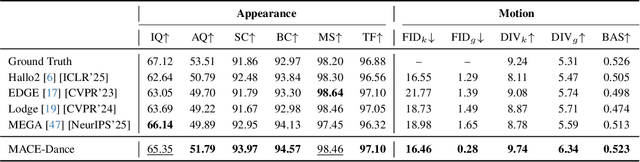
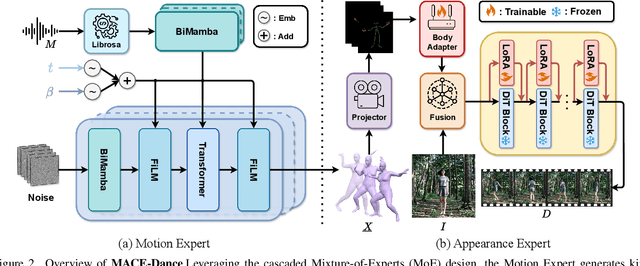
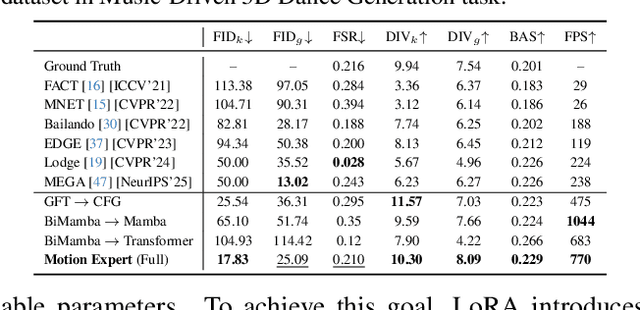
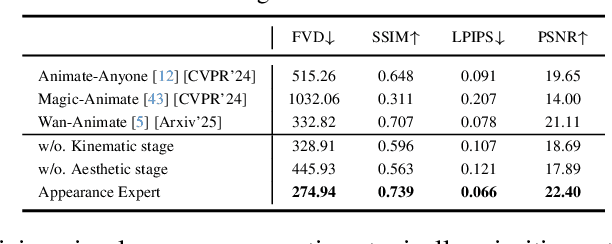
With the rise of online dance-video platforms and rapid advances in AI-generated content (AIGC), music-driven dance generation has emerged as a compelling research direction. Despite substantial progress in related domains such as music-driven 3D dance generation, pose-driven image animation, and audio-driven talking-head synthesis, existing methods cannot be directly adapted to this task. Moreover, the limited studies in this area still struggle to jointly achieve high-quality visual appearance and realistic human motion. Accordingly, we present MACE-Dance, a music-driven dance video generation framework with cascaded Mixture-of-Experts (MoE). The Motion Expert performs music-to-3D motion generation while enforcing kinematic plausibility and artistic expressiveness, whereas the Appearance Expert carries out motion- and reference-conditioned video synthesis, preserving visual identity with spatiotemporal coherence. Specifically, the Motion Expert adopts a diffusion model with a BiMamba-Transformer hybrid architecture and a Guidance-Free Training (GFT) strategy, achieving state-of-the-art (SOTA) performance in 3D dance generation. The Appearance Expert employs a decoupled kinematic-aesthetic fine-tuning strategy, achieving state-of-the-art (SOTA) performance in pose-driven image animation. To better benchmark this task, we curate a large-scale and diverse dataset and design a motion-appearance evaluation protocol. Based on this protocol, MACE-Dance also achieves state-of-the-art performance. Project page: https://macedance.github.io/
UrbanFeel: A Comprehensive Benchmark for Temporal and Perceptual Understanding of City Scenes through Human Perspective
Sep 26, 2025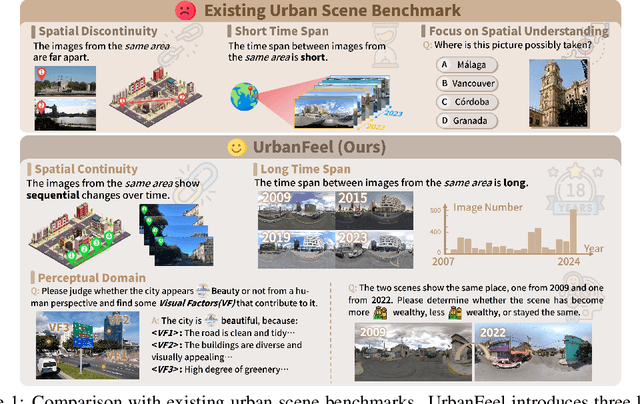
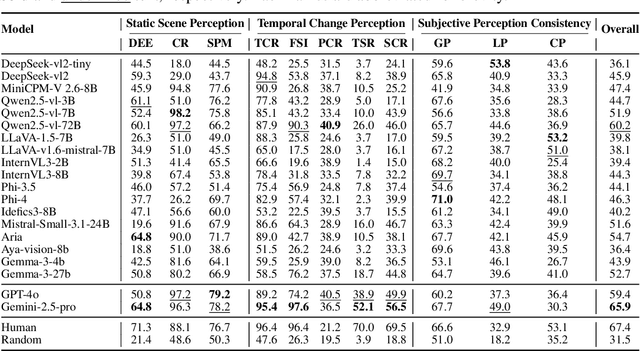
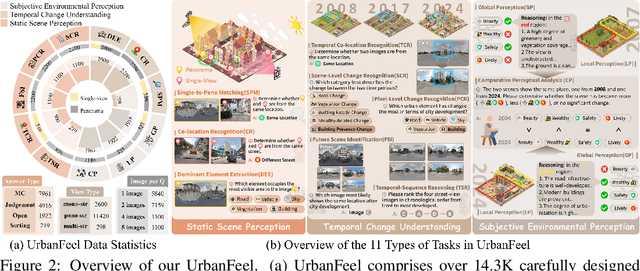
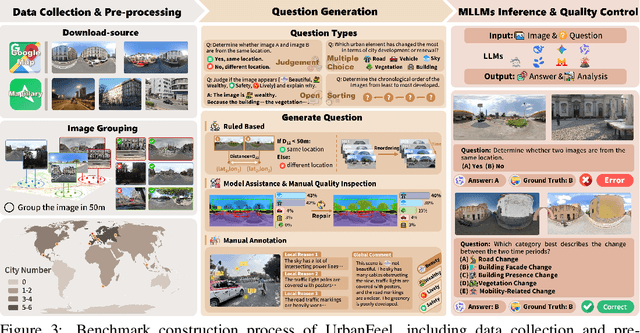
Urban development impacts over half of the global population, making human-centered understanding of its structural and perceptual changes essential for sustainable development. While Multimodal Large Language Models (MLLMs) have shown remarkable capabilities across various domains, existing benchmarks that explore their performance in urban environments remain limited, lacking systematic exploration of temporal evolution and subjective perception of urban environment that aligns with human perception. To address these limitations, we propose UrbanFeel, a comprehensive benchmark designed to evaluate the performance of MLLMs in urban development understanding and subjective environmental perception. UrbanFeel comprises 14.3K carefully constructed visual questions spanning three cognitively progressive dimensions: Static Scene Perception, Temporal Change Understanding, and Subjective Environmental Perception. We collect multi-temporal single-view and panoramic street-view images from 11 representative cities worldwide, and generate high-quality question-answer pairs through a hybrid pipeline of spatial clustering, rule-based generation, model-assisted prompting, and manual annotation. Through extensive evaluation of 20 state-of-the-art MLLMs, we observe that Gemini-2.5 Pro achieves the best overall performance, with its accuracy approaching human expert levels and narrowing the average gap to just 1.5\%. Most models perform well on tasks grounded in scene understanding. In particular, some models even surpass human annotators in pixel-level change detection. However, performance drops notably in tasks requiring temporal reasoning over urban development. Additionally, in the subjective perception dimension, several models reach human-level or even higher consistency in evaluating dimension such as beautiful and safety.